Intelligent Intake & Decision Logic Architecture
A method for transforming ambiguous intake into scalable, defensible decisions
What this method is
Intelligent Intake & Decision Logic Architecture is a method for structuring how information enters a system so downstream decisions are coherent, scalable, and defensible.
It is used when organizations rely on fragmented intake sources, inconsistent evaluation rules, or manual judgment to make decisions that should be fast, predictable, and repeatable.
The method converts scattered inputs and subjective calls into a structured decision system that can scale without losing judgment quality.
The core problem this method addresses
Most teams assume their bottleneck is volume.
In practice, the constraint is almost always ambiguity.
Common symptoms include:
multiple intake sources collecting different information
inconsistent or incomplete data
unclear evaluation criteria
judgment calls made in Slack or meetings
downstream teams compensating for upstream uncertainty
When intake is poorly structured, decisions that should take seconds expand into reviews, escalations, and rework.
The system becomes neither fast nor trustworthy.
The core premise
Decisions do not scale through effort. They scale through structure.
If intake is inconsistent, no amount of automation, tooling, or staffing will produce reliable outcomes.
Intelligent Intake & Decision Logic Architecture treats intake not as a form problem, but as a decision system design problem.
Diagnose fragmentation at the intake layer
The first step is mapping how information actually enters the system.
This includes:
every intake source
every field variation
every manual override
every implicit decision point
every place humans intervene to compensate for missing structure
The goal is to identify where ambiguity is introduced — and how it propagates downstream.
Most systems fail here, long before decisions are made.
Design a structured intake architecture
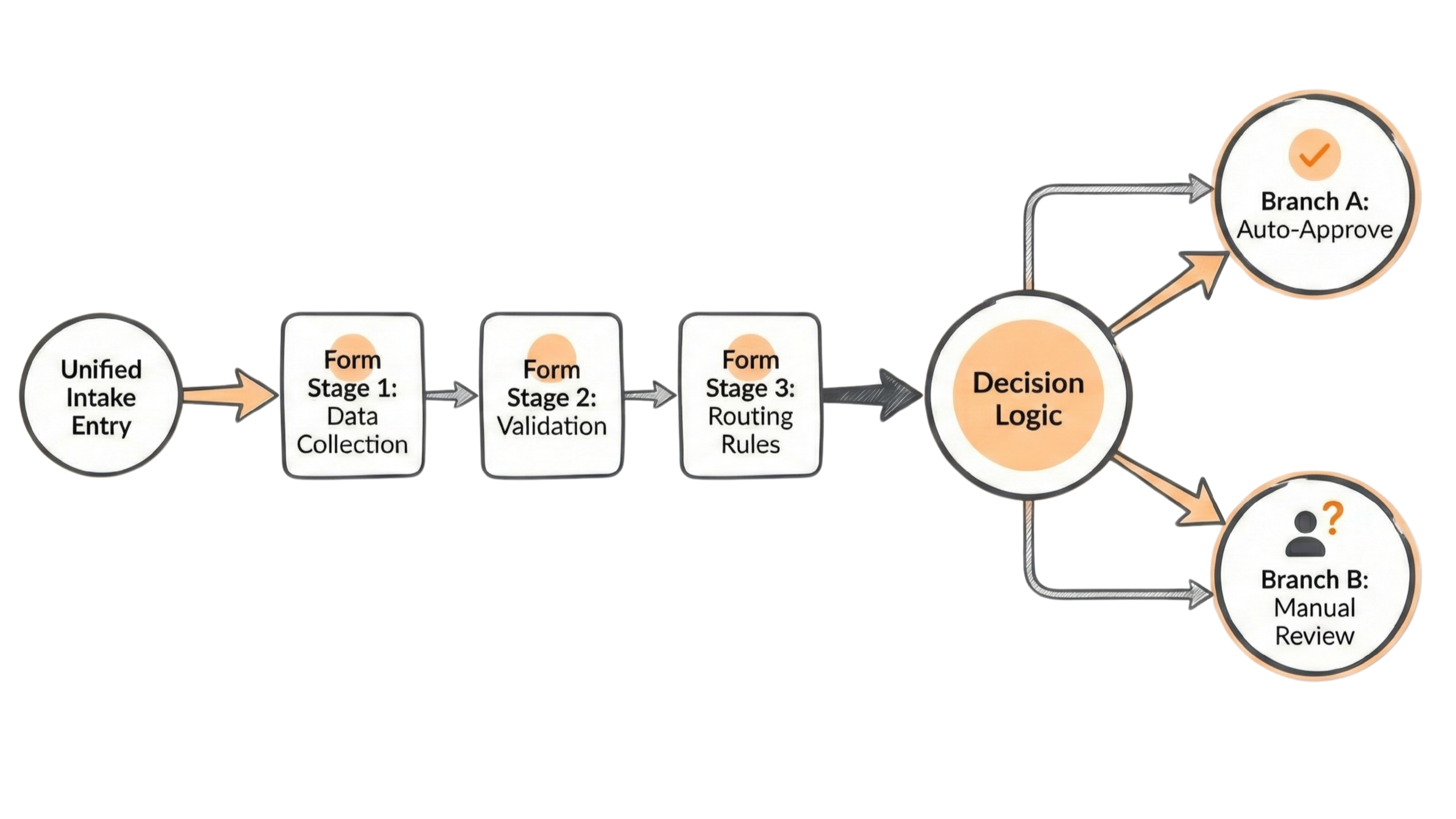
Once fragmentation is visible, intake is redesigned as a multi-stage system, not a single front-loaded form.
A typical structure includes:
Stage 1: clean data capture
Stage 2: validation and error-proofing
Stage 3: decision-relevant inputs and routing signals
Each stage collects only what is required at that point in the decision process.
This sequencing reduces noise, improves data quality, and sharply lowers cognitive load.
Ambiguity drops because the system no longer asks for everything at once — only what matters, when it matters.
Build an explicit decision logic layer
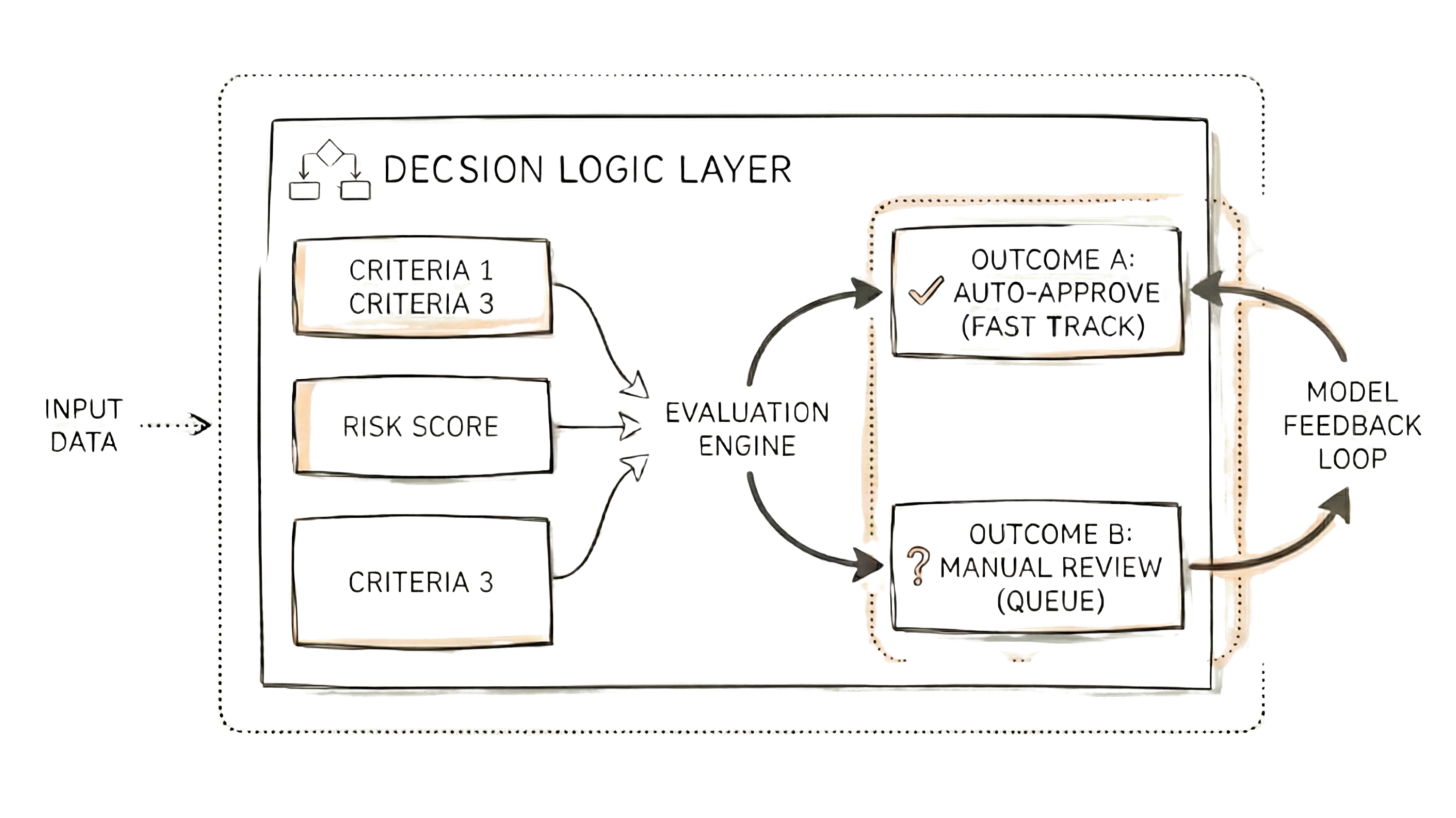
With structured intake in place, the method introduces a decision logic layer that makes evaluation rules explicit.
This typically includes:
clear criteria definitions
thresholds and disqualifiers
risk indicators
completeness checks
weighted evaluation rules
Instead of relying on tacit judgment, the system produces legible outcomes based on known logic.
Common outputs include:
auto-approval or fast-track paths
structured queues for manual review
explicit reasons for routing or escalation
Judgment is not removed — it is contained and governed.
Create learning without instability
A critical component of the method is designing feedback loops that allow decisions to improve over time without breaking the operational model.
This ensures:
evaluation criteria can evolve
thresholds can be adjusted
edge cases can be incorporated
…without reintroducing chaos or manual workarounds.
The system learns while remaining stable.
What changes when intake and logic are explicit
When intake and decision logic are properly structured, systems behave differently:
decisions happen faster with fewer escalations
downstream teams receive clean, reliable inputs
manual review volume drops
routing becomes predictable
leadership gains confidence in how decisions are made
Most importantly, scale no longer increases risk.
The Work
Relationship to downstream operations
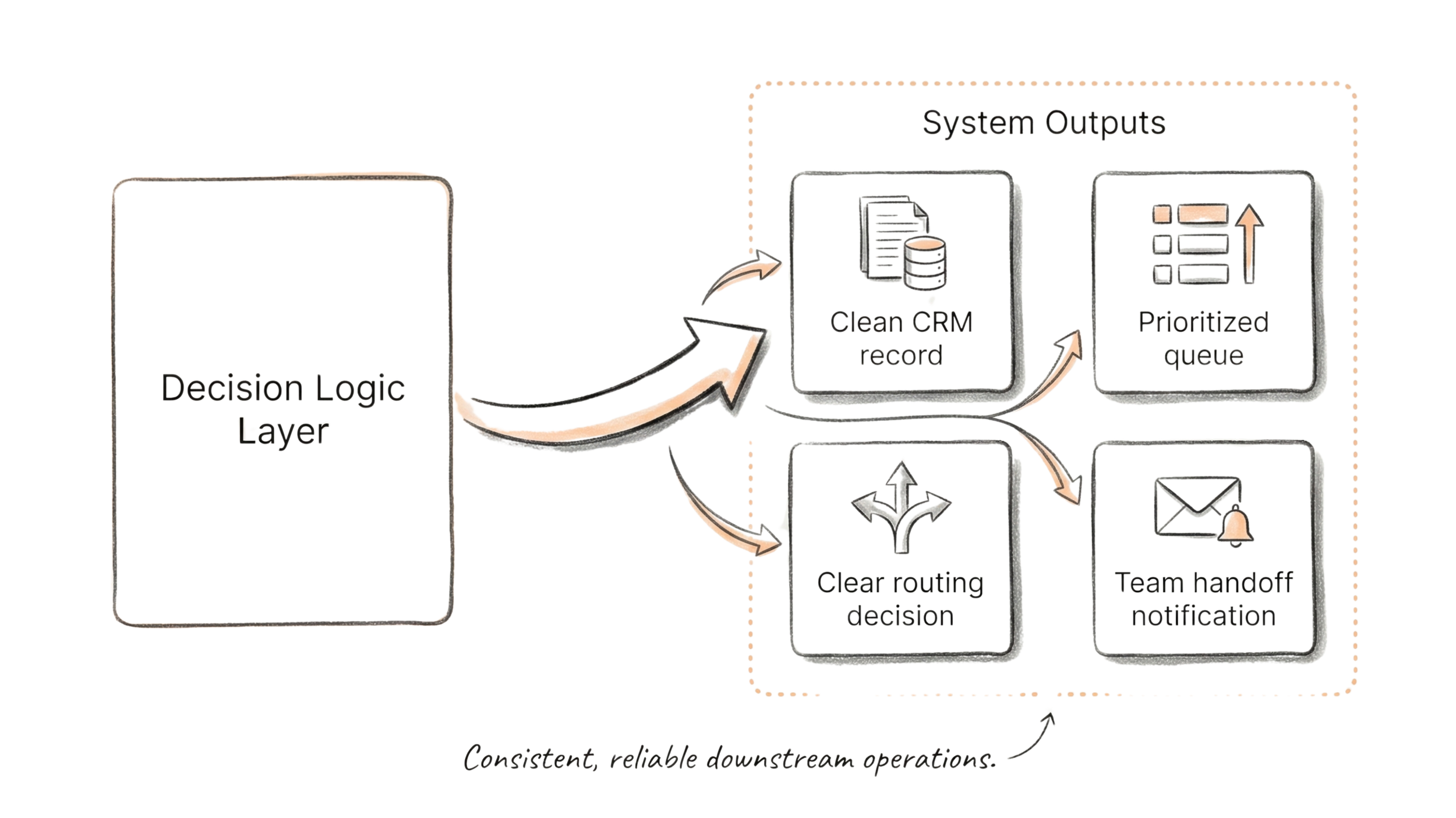
A clean decision layer allows downstream systems to function as intended.
Reliable intake and logic enable:
accurate CRM records
prioritized queues
consistent handoffs
automated notifications and workflows
Downstream teams no longer compensate for upstream ambiguity — the system carries the load.
Where this method is most applicable
Intelligent Intake & Decision Logic Architecture is particularly effective when:
decisions rely heavily on judgment
intake volume is increasing
multiple teams depend on shared evaluation rules
automation initiatives keep stalling
downstream errors trace back to upstream inconsistency
It is often foundational to automation, AI, or productization — but delivers value even without those layers.
What this method is not
It is not a form redesign.
It is not a rules engine bolted onto chaos.
It is not automation-first.
It is not a tool-selection exercise.
It is a method for making decision logic explicit, governable, and scalable.
How this method is used
Intelligent Intake & Decision Logic Architecture is a foundational method used within broader decision audits, attribution design, and system-framing work where intake quality determines execution quality.