Decision Portfolios: Designing How Organizations Choose What to Work On
TLDR: Strategy is not choosing the best ideas. It is choosing a set of ideas that behave well together.
Over time, you start to notice a quiet pattern in how organizations choose what to work on. Not in how initiatives are executed—most teams are quite good at shipping—but earlier, in the moment of selection. In the meetings where priorities are ranked, roadmaps are assembled, and strategic bets are chosen.
Most prioritization processes treat decisions as independent. Each idea is evaluated on its own merits, scored, ranked, and compared. The assumption is straightforward: if you choose the strongest individual initiatives, you end up with a strong strategy. In practice, it rarely works that way.
What matters is not just whether an initiative is good on its own. It is how it behaves alongside the others. What assumptions it shares. What risks it concentrates. What territory it leaves unexplored.
It is easy to end up with a portfolio of choices that all lean in the same direction. Five initiatives that target the same customer segment. Five product bets that depend on the same underlying platform. Five growth experiments that assume the same macro conditions. Individually, each choice can be defensible. Together, they form a narrow corridor of possibility. When that corridor shifts, the organization feels exposed, even if execution was flawless.
I have seen teams with immaculate execution struggle because every major bet shared the same underlying assumption. When that assumption moved, everything moved with it.
This clustering is rarely intentional. It emerges from how people prioritize. We reward confidence, familiarity, and near-term impact. Diversity of direction is harder to score, harder to defend in a meeting, and harder to justify in a quarterly plan. Yet it is often what creates resilience.
Finance learned this lesson long ago. Investors rarely allocate capital to the five highest-return assets. They spread capital across uncorrelated bets, not because any single asset is perfect, but because the system behaves better as a whole. Organizations also allocate capital, just in different forms. Time, attention, headcount, and executive judgment are finite. Each initiative consumes some portion of that budget and returns learning, revenue, or strategic positioning. Seen this way, strategy begins to look less like prioritization and more like portfolio construction.
What this means in practice is that initiatives should be evaluated not only by their individual expected value, but by how they interact as a set under real constraints. The map below frames initiatives as a portfolio, showing how organizations implicitly cluster bets, where risks correlate, and how a constrained selection should maximize both impact and strategic diversification.
Each dot represents a real initiative competing for limited organizational attention. The horizontal axis reflects expected value. The vertical axis reflects strategic optionality — how much an initiative expands or constrains future paths. Gray regions show clusters of initiatives that share underlying assumptions or dependencies.
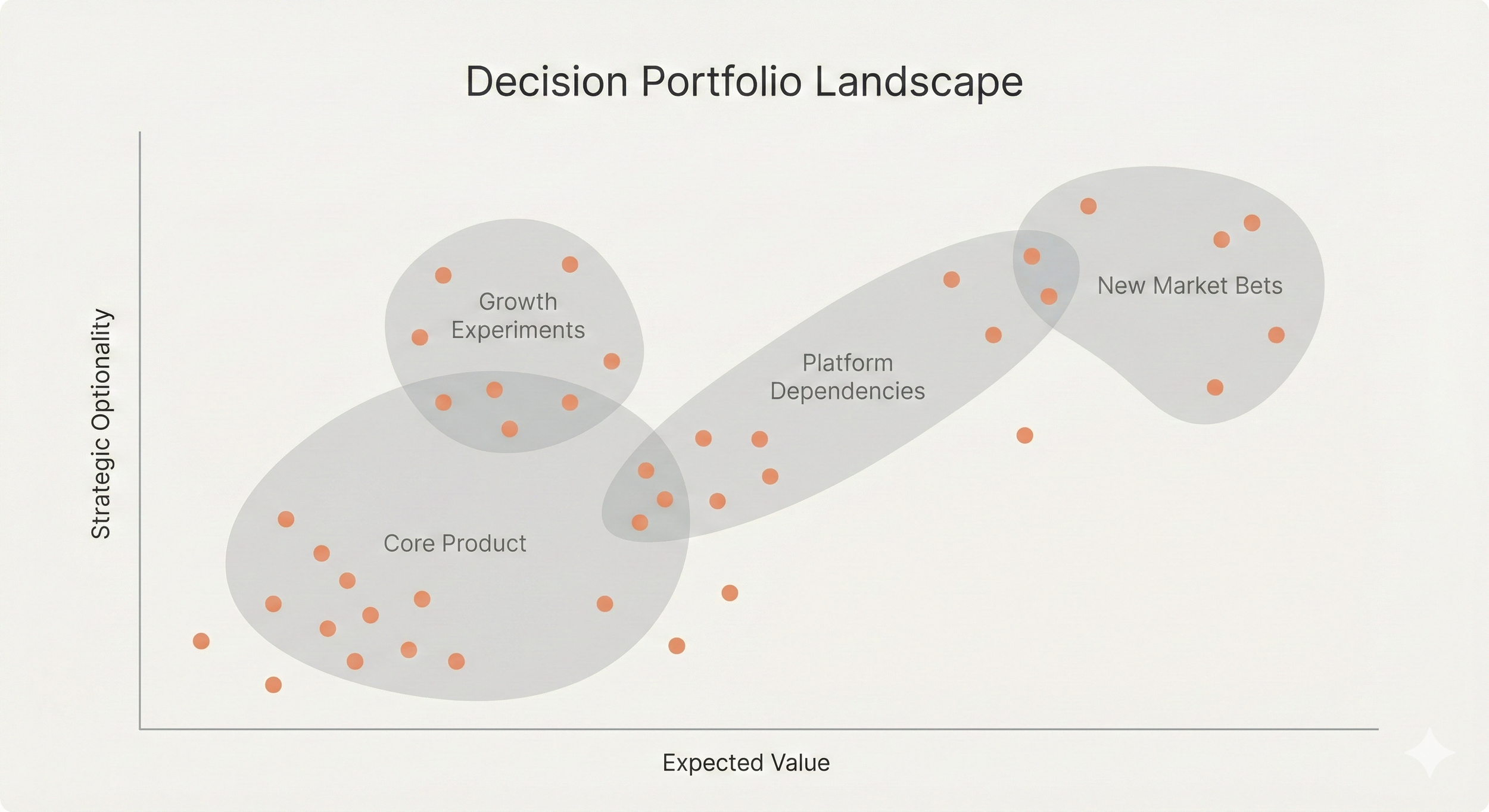
Exhibit 1a: Decision Portfolio Landscape — mapping initiatives by expected value and strategic optionality to reveal clustering, shared assumptions, and correlated risk across an organization’s current set of bets.
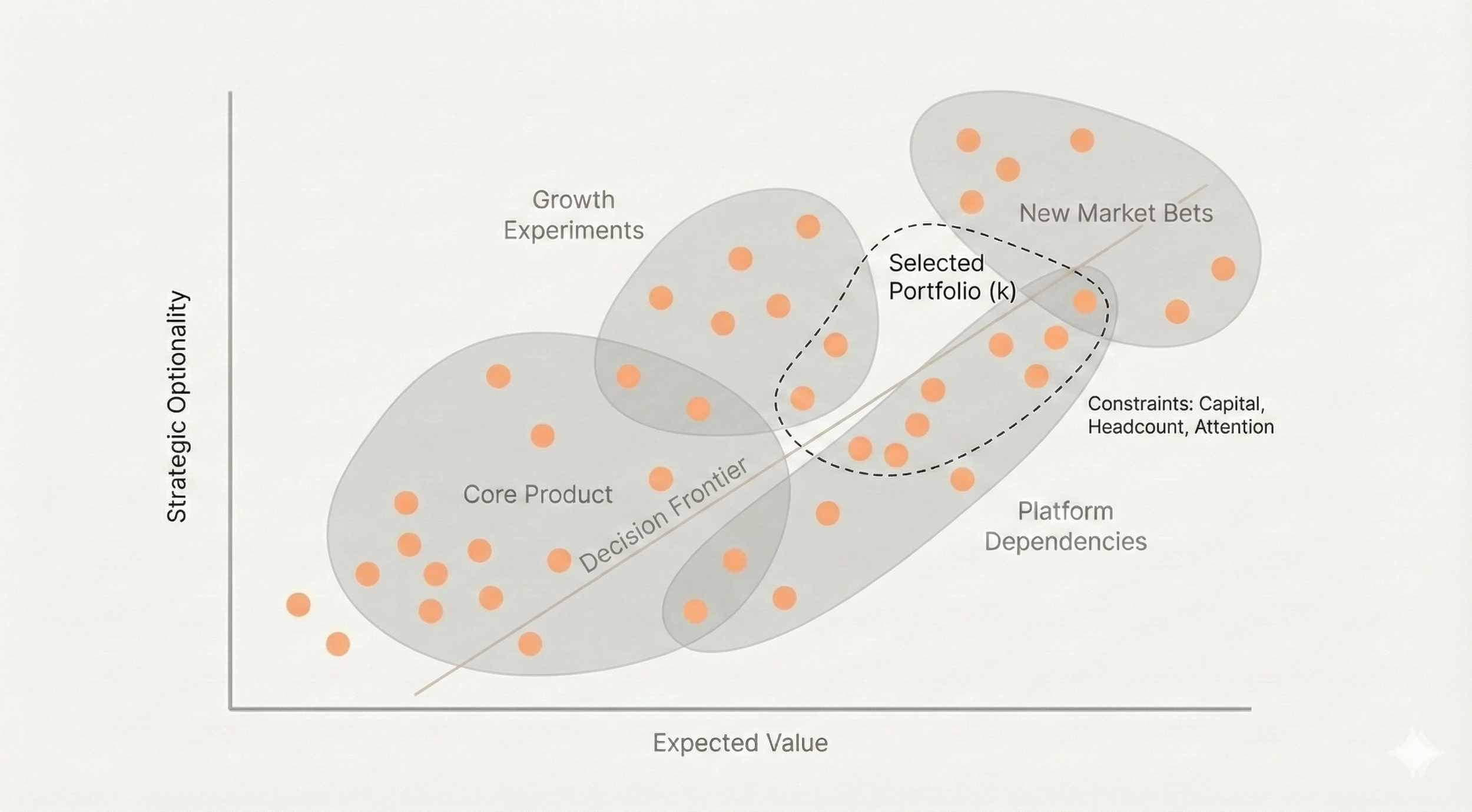
Exhibit 1b: Decision Portfolio Selection — illustrating how a constrained portfolio is deliberately chosen along the decision frontier to maximize combined impact and diversification under capital, headcount, and attention limits.
Each dot represents an initiative. Clusters indicate shared assumptions and correlated risk. The decision frontier marks the boundary where initiatives deliver the highest combined impact and diversification under capital, headcount, and attention constraints. The selected portfolio is not the highest-scoring set of ideas, but the set that behaves best together. Most organizations optimize initiatives locally. Decision portfolios optimize decisions globally.
A similar selection problem appears in modern AI systems. When training models, researchers must choose a limited subset of data from vast possibilities. Selecting only the highest-scoring examples often produces redundancy. Many samples look different on the surface but represent the same underlying pattern. Recent work in AI research (e.g., Google Research, NeurIPS 2025) shows that structured selection—choosing examples that are both high-quality and meaningfully different—produces better models with fewer resources. Organizations, in many ways, are learning systems too. They train themselves through the initiatives they pursue, the markets they explore, and the constraints they encounter. The selection problem is the same. Value matters, but diversity of direction matters as well.
When you start to see initiatives as a portfolio rather than a ranked list, different questions emerge. Which bets share the same underlying assumptions? Where are risks correlated in ways that are easy to miss? Which initiatives expand strategic territory rather than reinforcing what is already known? How does the set behave if a key variable changes, such as market demand, regulation, or internal capacity? This does not require complex math to be useful. It requires making the structure visible.
Much of the conversation around decision architecture focuses on workflows: how requests are routed, who owns decisions, where automation fits. That layer matters because it determines how quickly and consistently organizations act. But there is a layer above workflows that often remains implicit: which decisions deserve workflows at all. Portfolio architecture sits there.
Decision portfolios sit within a broader organizational decision system. Beneath them are the inputs and logic that shape choices, and above them are the execution mechanisms that turn choices into outcomes. The framework below shows where portfolio design fits in the full decision architecture of an organization.
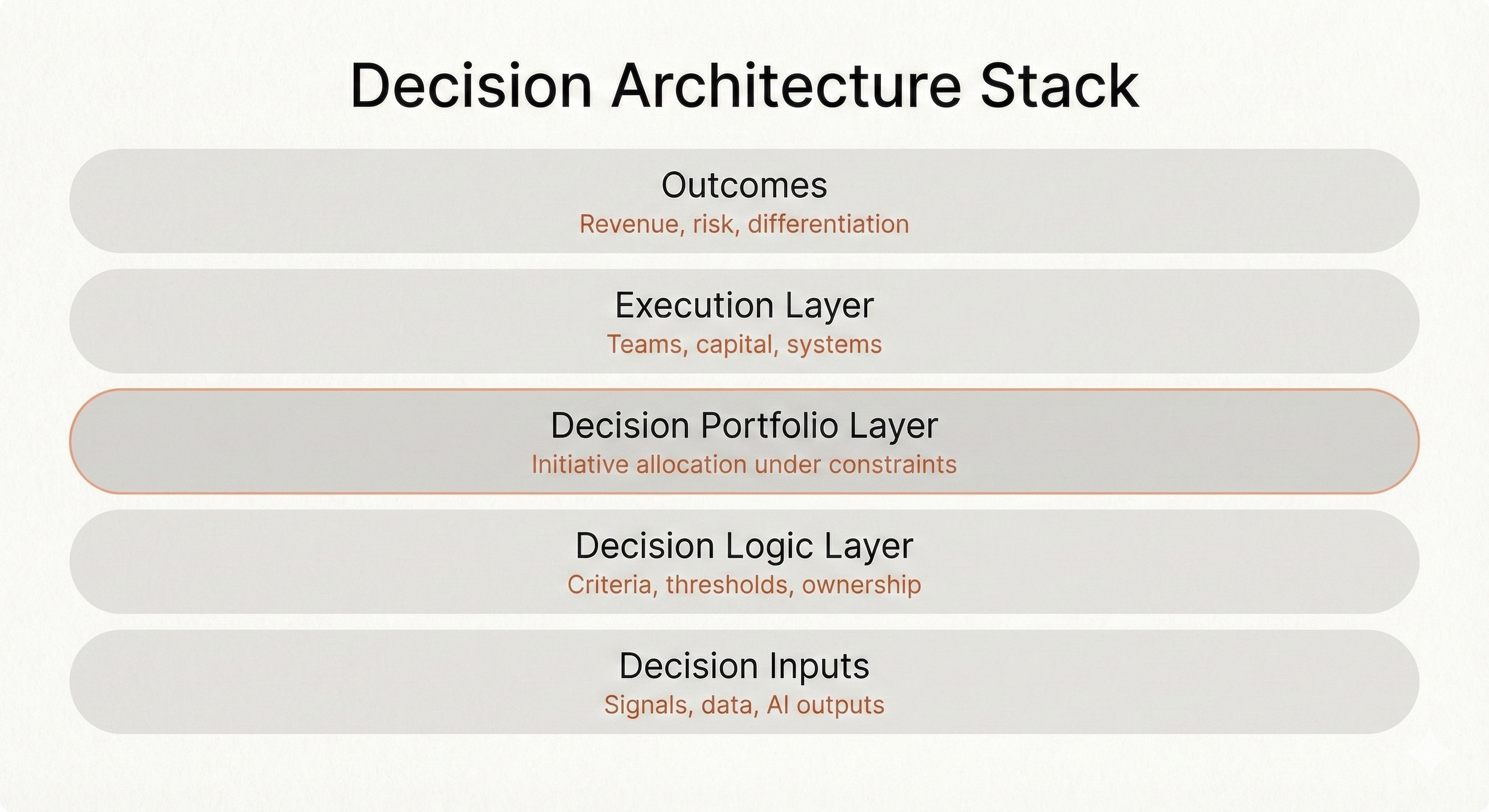
Exhibit 2: Decision Architecture Stack — where organizations structure how decisions become outcomes.
AI does not create better decisions. It accelerates whatever decision architecture already exists.
Organizations do not just make decisions; they architect how decisions are generated, selected, and executed. Data and AI shape the input and logic layers. Teams and capital execute. The portfolio layer sits in between, where leadership allocates attention under constraint. This is where strategy becomes structural rather than rhetorical.
When portfolios are explicit, strategy starts to feel less like a debate over rankings and more like a design problem. Attention becomes a resource to allocate. Risk becomes something to distribute rather than avoid. Optionality becomes something to cultivate. This does not eliminate judgment. It gives judgment a structure.
Strategy also starts to feel less like choosing the next step and more like laying out a course. You are not just moving forward; you are deciding which directions remain open.
Rivington works at the decision layer, where ambiguity becomes execution constraints. Decision portfolios extend that lens upstream. Before workflows, before automation, before AI copilots, there is the question of what deserves focus in the first place. Decision architecture is not only about how work flows. It is about how attention is allocated. As organizations adopt AI, this becomes more pronounced. Automation amplifies whatever structure exists. If the portfolio is narrow, AI accelerates narrowness. If the portfolio is intentionally diversified, AI accelerates learning and adaptation.
Organizations rarely fail because they lack ideas. In reality, they often fail because they select ideas without seeing how those selections interact. Viewing initiatives as a portfolio offers a different way to see strategy. Less as a list of priorities and more as a system of bets that shape what an organization can learn, become, and respond to. Clarity, in this sense, is not just about faster decisions. It is about choosing a set of decisions that keeps the organization open to the future.
This essay is informed by recent research on data selection and diversification in AI systems (Google Research, NeurIPS 2025).